
In a world screaming with noise, iconic brands whisper. They don’t overwhelm; they enchant. Simplicity is their blade, cutting through chaos to pierce the soul. George A. Alvarez, a Harvard cognitive scientist, notes that the brain craves fluency—designs that feel effortless to process. A 2013 study in the Journal of Consumer Psychology confirms this: simple visuals spark trust and desire, like a lover’s glance that says everything without words.
Consider Apple’s logo. A single, bitten apple—sleek, primal, eternal. It’s not just a fruit; it’s Eve’s rebellion, Newton’s gravity, and Jobs’ genius distilled into a silhouette. Ernest Hemingway, the master of sparse prose, taught us that every word, every line must earn its place. At our studio, we channel this ruthlessness, stripping away excess until only the brand’s beating heart remains. Our websites load in a breath, their navigation as intuitive as a child’s first step.
Nike’s “Just Do It” is a three-word novel, a call to arms that echoes across borders. Harvard marketing professor Gerald Zaltman argues that simplicity taps into our unconscious, where 95% of decisions are born. When we design, we don’t clutter—we curate, knowing that in a glance, a user decides to stay or flee. Simplicity isn’t minimalism; it’s poetry.
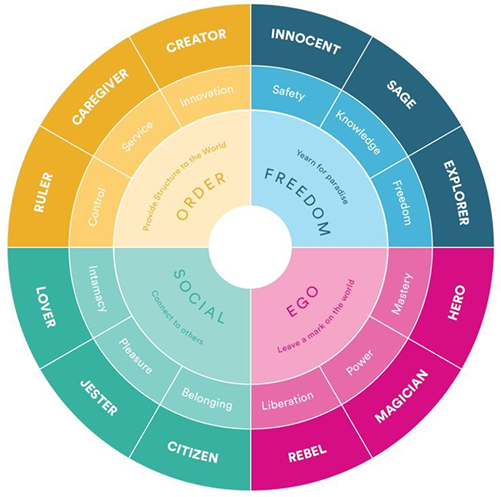
Great brands don’t invent; they resurrect. They summon archetypes—those ancient, Jungian patterns that live in our collective psyche. The Hero, the Sage, the Rebel—these are the ghosts that haunt every epic, from Homer’s Odyssey to modern branding. Harvard’s Joseph Campbell scholar, Maria Tatar, reminds us that archetypes are universal because they mirror our deepest desires and fears.
Harley-Davidson roars as the Outlaw, its chrome gleaming with the promise of untamed freedom. Disney, the Innocent, wraps us in a cocoon of wonder, its castles glowing like childhood itself. At our studio, we don’t just design logos; we summon myths. A tech startup might rise as the Creator, its palette bold with innovation. A wellness brand could cradle as the Caregiver, its curves soft with empathy.
Why do archetypes work? A 2018 Marketing Theory study reveals they forge emotional loyalty by bypassing reason for raw instinct. As Toni Morrison wove archetypes into her novels to make characters feel eternal, we weave them into branding—through color, imagery, tone. A website’s hero banner might pulse with the Explorer’s wanderlust; a tagline might carry the Sage’s quiet wisdom. The result is a brand that feels like it’s always been yours.
We are not creatures of logic; we are creatures of story. Harvard neuroscientist Daniel Schacter shows that narratives light up our brains, flooding them with dopamine and binding us to the teller. Iconic brands don’t pitch—they weave spells. They invite us into worlds where we are not customers, but co-conspirators.
Patagonia doesn’t sell jackets; it summons us to save the earth. Its rugged imagery, activist campaigns, and raw, honest voice form a saga of rebellion and hope. A 2020 Harvard Business Review study found purpose-driven brands like Patagonia boost retention by 20%, because stories align values with action. As Chimamanda Ngozi Adichie crafts novels that make strangers feel like kin, we craft brand narratives that turn audiences into tribes.
Storytelling isn’t just copy. It’s the arc of a website’s user journey, the slow reveal of a logo animation, the cadence of a social post. For a luxury brand, we might spin a tale of heritage, each serif dripping with exclusivity. For a startup, we’d craft a myth of disruption, bold and electric. Drawing on Zaltman’s insight that 95% of decisions are emotional, we map the audience’s desires and fears, creating stories that don’t just sell—they possess.